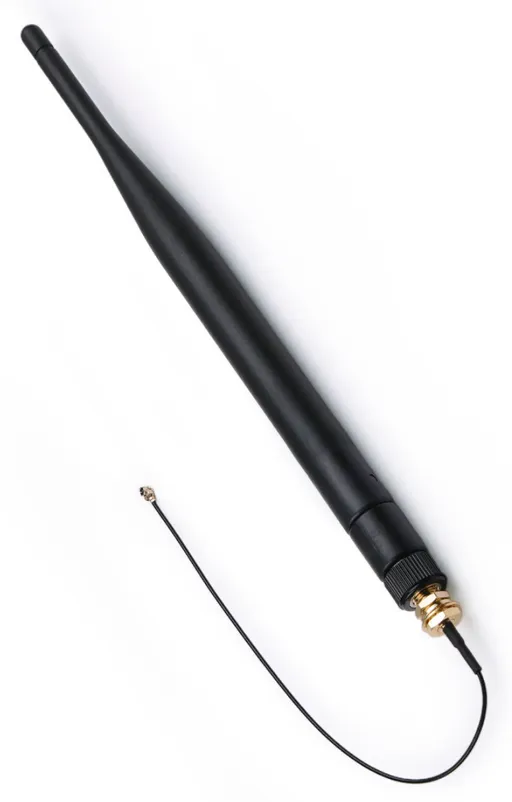
Specifications
- Gain
- 1.5dBi
- Size
- 55mm × 10mm (flat PCB)
- Price Range
- $8-15
Pros & Cons
Pros
- ✓ Ultra-thin and flat — hides inside an enclosure or sticks to a surface
- ✓ Self-adhesive backing — no drilling, no connectors
- ✓ Purpose-designed for tight IoT enclosures where a whip won't fit
- ✓ Taoglas quality: real specs, consistent manufacturing
- ✓ I.PEX MHF4 / U.FL connector — low-profile internal mount
Cons
- ✗ Low gain (1.5 dBi) — for coverage, not range
- ✗ Placement critical — performance degrades near metal/ground planes
- ✗ U.FL connector is fragile — limit reconnection cycles
- ✗ Not suitable as a primary antenna for outdoor/range-focused nodes
- ✗ Requires enclosure design consideration for optimal pattern
Where to Buy
Taoglas FXP73 Flexible PCB Antenna
Overview
The Taoglas FXP73 is a flat, flexible PCB antenna designed for 868/915 MHz IoT devices where a traditional whip won’t fit. It’s the type of antenna used inside sealed consumer IoT products — think smart home sensors, asset trackers, and compact LoRa nodes.
Form Factor
This isn’t a “better” antenna — it’s a different antenna for a different situation. The FXP73 sticks inside a case lid or along a cable run, completely hidden. There’s no external protrusion, no connector to break off.
That’s its entire value proposition: invisible, space-zero installation at modest gain.
Performance Reality
At 1.5 dBi, this antenna is below dipole-equivalent. Its pattern is also strongly influenced by nearby objects — the ground plane, the PCB it sits on, and any metal in the enclosure all affect real-world performance significantly.
In ideal placement (mounted on lid of a plastic case, away from metal), it performs close to a stub whip.
In poor placement (next to battery, on a metal panel), performance degrades substantially.
When to Use
- Fully sealed, compact node enclosures where an external antenna isn’t practical
- Indoor sensors where “good enough” coverage in a room is the goal
- Wearable or compact carry nodes
- Nodes that will be repositioned frequently and a whip would catch on things
When NOT to Use
- Outdoor long-range nodes — a fiberglass whip is dramatically better
- Any enclosure with significant metal content near the antenna
- Primary mesh backbone nodes where link quality matters