Mesh Technologies
Mesh Radio: using radio networks where intermediate devices relay messages to extend the range, scalability and reliability of communication.
Many technologies can used for mesh networking as noted in the sidebar. We mainly focus on the Lora-based options as they are popular, publicly available, & so particularly relevant to Vashon Island & Salish Sea communities. Other options are noted in the sidebar.
LoRa — Long Range Radio
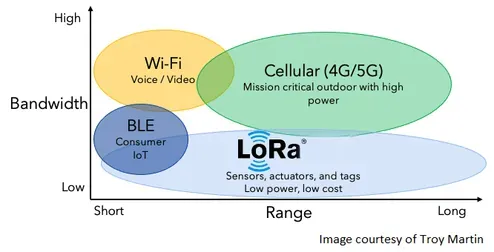
LoRa vs Wi-Fi vs Cellular vs Bluetooth — courtesy Troy Martin
 Semtech owns the LoRa IP and has produced over 500 million of the SX1262
(& upcoming LR2021) radio chips behind nearly every LoRa mesh node.
Semtech owns the LoRa IP and has produced over 500 million of the SX1262
(& upcoming LR2021) radio chips behind nearly every LoRa mesh node.
- Long range, low bandwidth communications.
- Invented by the Grenoble start-up Cycleo, acquired in 2013 and since developed by Semtech.
- The underlying technology for much of this mesh networking.
- Uses unlicensed, internationally reserved public radio bands for industrial, scientific and medical (ISM) purposes.
- The same spectrum is reserved for baby monitors, cordless phones, garage door openers, thermostats, irrigation systems, all these competing throughout Pacific NorthWest neighborhoods.
- North & South America: 902 - 928 MHz range, 915 MHz center, 26 MHz bandwidth.
- Wikipedia: LoRa ↗
Networking Schemes Built on LoRa
Vashon will start with MeshCore, but may adopt other technologies in parallel if there is desire.
Point to Point (PTP)
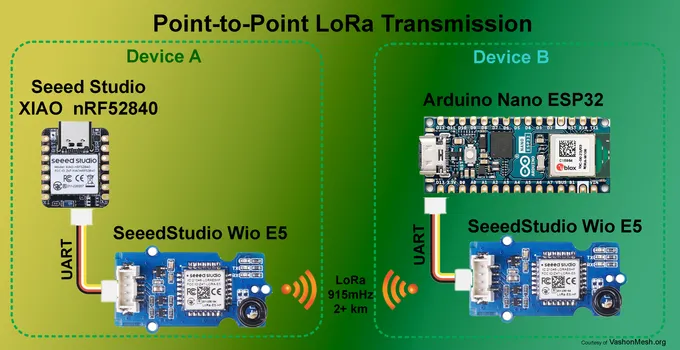
Two devices can simply talk directly to one another using AT commands. For instance, SeeedStudio's Wio $18 chips can implement basic point-to-point code.
LoRaWAN
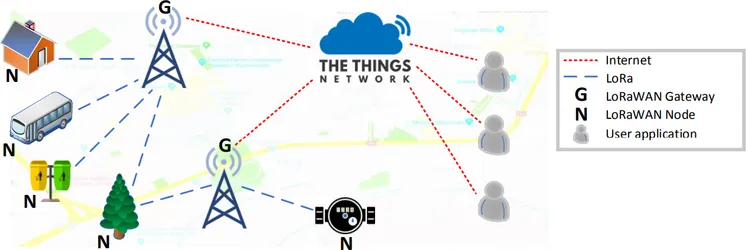
The big industry consortium — great for sending lots of sensor data to the cloud for data analysis from Smart Cities, Smart Agriculture, Smart Manufacturing, Smart Health, etc.. Not optimized for peer-to-peer messaging.
Also see The Things Network ↗ which is open source alternative that shares many goals of the LoRaWAN consortium.
Meshtastic
Great for casual groups at an event or out in the wilderness. First on the scene, so very popular.
- Every message is broadcast to all other radios, which themselves repeat the messages (flood routing).
- Default 3-hop limit (configurable up to 7) limits how far messages can spread.
- Text messages have a 240-character limit.
- Relies solely on LoRa technology, using the identical devices that work with MeshCore.
- Many users in an urban environment can flood the network, as the mesh algorithm encourages lots of message repeating.
MeshCore Vashon's Choice

Great for 131 to 200 character text conversations in a larger region with fixed repeaters. Relies solely on LoRa technology.
- Companion radios transmit directly to neighboring radios — but never relay or repeat messages.
- Instead companion radios also transmit to repeaters, and those do relay the messages up to 64 hops, which can carry the signal far & wide. Repeaters forward all messages to other repeaters, and to any companion radios in range.
- All messages are encrypted at a low level. Companion radios can decrypt all public channels, and secret-key channels if they have the shared key.
- Repeaters can be setup - with some downsides - as a room server that caches (only) 16 messages, allowing companion radios to be temporarily outside repeater network, but then catch up on recent messages.
- Messages are preserved on radios with a rolling buffer, the size determined by the radio's available memory.
- No priority recognition — competing with baby monitors, cordless phones, garage door openers, thermostats, irrigation systems systems, throughout Seattle and Tacoma's neighborhoods.
Key Characteristics
Learns and caches optimal routes rather than flooding every message
Only infrastructure nodes (repeaters, room servers) forward traffic
The MeshCore C++ library automatically encrypts everything, using ed25519 identity with ECDH (Elliptic Curve Diffie-Hellman) in the x25519 curve, then AES128 per-message encryption. Client apps don't need to handle this themselves.
Runs on ESP32, nRF52, RP2040 (e.g., Raspberry Pi), and STM32 platforms
Channels & Privacy
- Supports 40 channels, including a general public channel.
- #public channels — anyone using the same name can communicate
(e.g.,
#vashon-maury) - Secret-key channels — only those with the shared key can communicate (good for medical teams or EMCOMM groups)
- Requires manual advertising your presence on the network.
Reticulum
- The key developer moved on to other projects late in 2025, but the software is open-source and complete, so it can still be used and maintained by the community.
- A network protocol stack, not just an application.
- This allows for seamless integration of various communication methods, 'glue' to connect all the other networks.
- Fully encrypted traffic, with deeper integration at all levels of the stack.
- Heterogeneously connects: LoRa, LAN, point-to-point Wi-Fi/microwave, the internet, Tor, I2P, packet radio, and any supported interface.
- Optimized message routing for distance and network resources - it learns and chooses the best path based on current conditions and network capacity.
- Global address space — no central authority needed for IP addresses.
- Wide ecosystem of compatible software — encrypted messengers, BBS-style community clients, and protocol tools, all working transparently over any Reticulum interface including LoRa.
Notable apps from the Reticulum software ecosystem ↗:
"The only solution that promises to let people create local networks, large and small, and interconnect those networks organically into a seamless, global mesh."
Comparisons & Further Reading
- LoRa vs LoRaWAN: SeeedStudio Blog ↗
- MeshCore vs Meshtastic: Austin Mesh ↗ also NodakMesh Comparison ↗
- SeeedStudio makes excellent LoRa hardware: SeeedStudio LoRa products ↗
- TAK integration: KISS LoRa TAK ↗
- UISP Design Center ↗