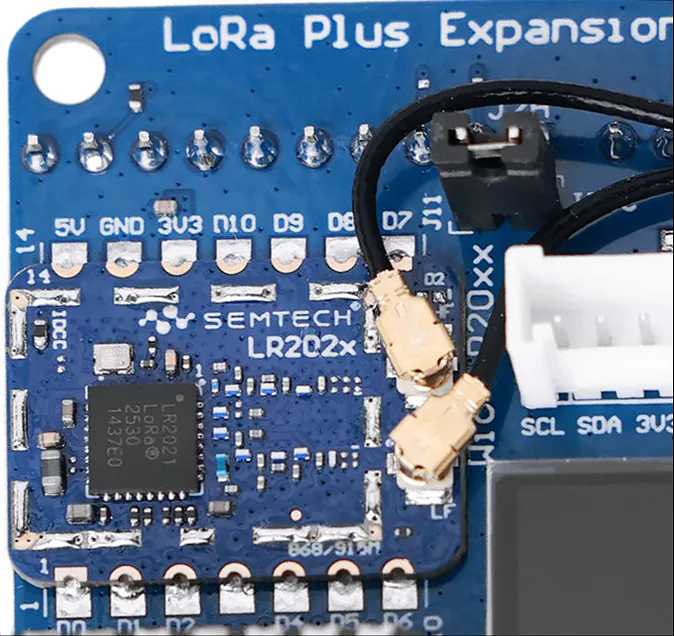
Great New LoRa Chip #2 - The LR2021
MeshCore should be able to support LR2021 since it is supported by RadioLib!
Noodling around on the internet one can find enhanced versions of the popular SemTech SX1262 chip many of our devices use for LoRa communications. First I looked at the SX1302, but it’s a closed device, hence there’s no library support for that.
However then I started looking into the fourth-generation Semtech LR2021
High-Speed Breakthrough
The fourth-generation Semtech LR2021 not only retains the ultra-long-range communication of traditional LoRa but also introduces the new FLRC modulation, achieving a remarkable communication rate of up to 2.6 Mbps. This capability extends its use to bandwidth-sensitive applications, such as audio streaming and image transmission.
Looking at the Semtech specifications though, it clarifies that FLRC provides up to 2.6Mbps bandwidth (at double Bluetooth’s range), but LoRa bandwidth is upped to 200kbps, compared to 62.5kbps with the existing SX1262 chip. So that still works out to a 3.2x enhancement in LoRa bandwidth, for the 1st chip in this new Semtech family!
One Hardware, Global Coverage
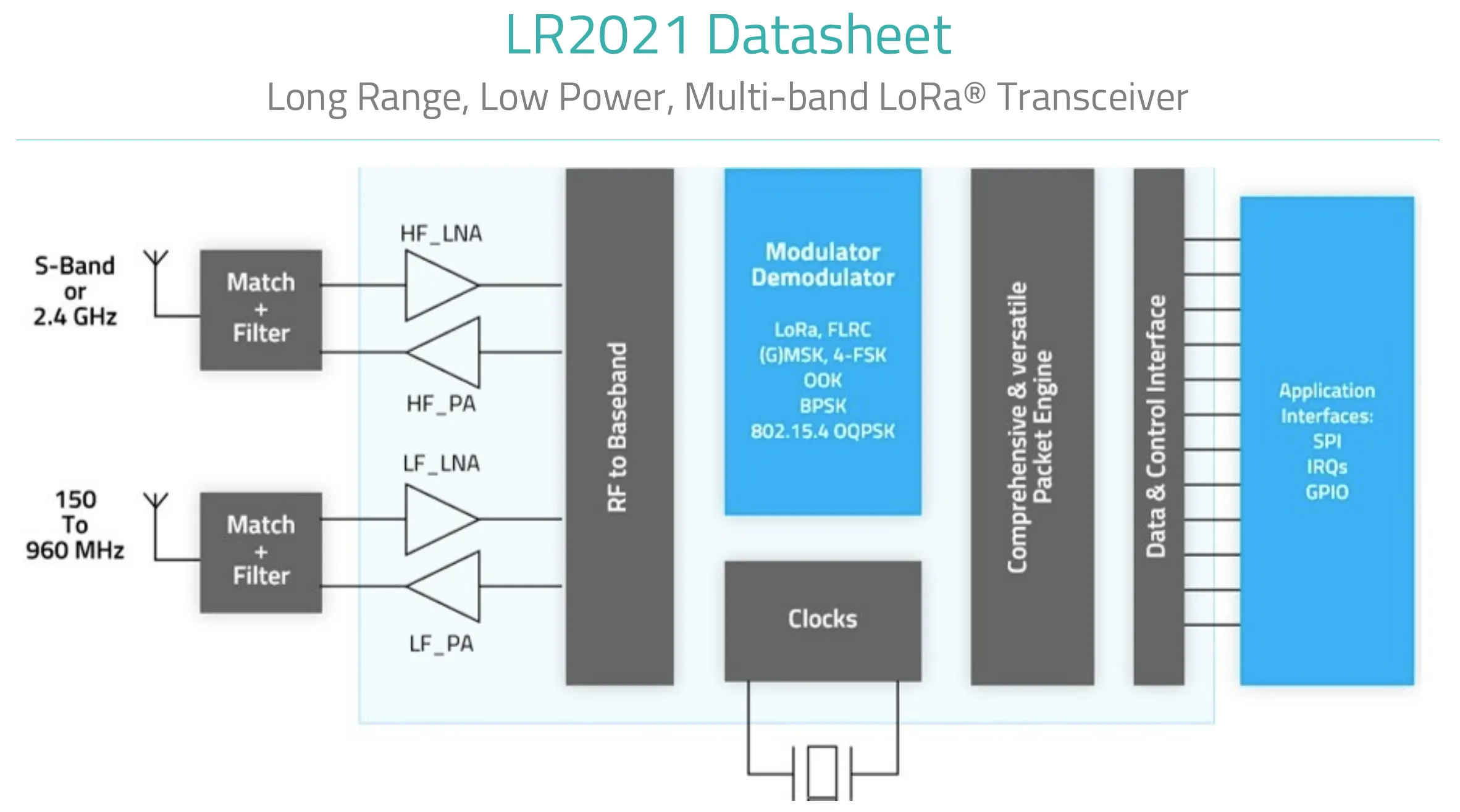
With broad dual-band coverage (Sub-GHz & 2.4GHz), a single hardware design achieves global compatibility. This will streamline design processes.
Universal Platform
By integrating multiple modulation schemes (LoRa, FLRC, FSK, OQPSK) within a single silicon platform. LR2021 allows developers to choose the optimal combination for any scenario from ultra-low-power sensors to high-speed-controls without hardware redesign. Compatible with various low-power wireless protocols including Amazon Sidewalk, W-MBUS, Wi-SUN FSK, and Z-Wave, LR2021 enables true one-platform-fits-all development.
Best-in-Class Energy Efficiency & Performance
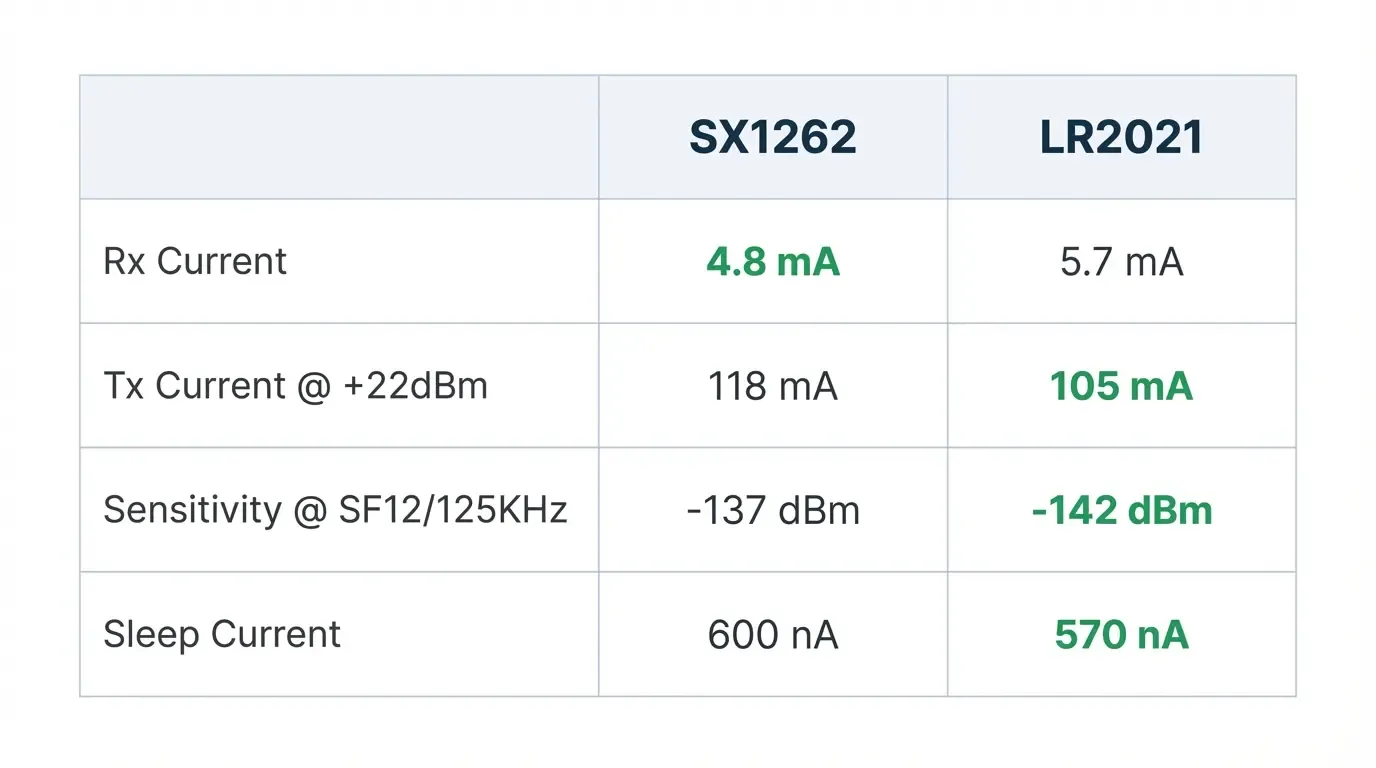
LR2021 delivers a definitive generational leap, outperforming predecessors like the SX1262 across most key metrics. Lower transmission current and higher receiving sensitivity translates directly into longer battery life and more reliable connections for devices.
Enhanced Channel Activity Detection (CAD)
The LR2021 employs Fast CAD technology featuring an intelligent adaptive threshold and early termination mechanism, which substantially reduces both the power consumption and time required for idle channel detection, improving device energy efficiency.
Details & Resources
Semtech’s LoRa Plus™ family - Semtech’s LoRa Plus™ family incorporates a fourth-generation LoRa® IP and supports both terrestrial and SATCOM networks in the sub-GHz, 2.4 GHz ISM bands and licensed S-band. Designed to be backward compatible with previous LoRa devices to ensure seamless LoRaWAN® compatibility, the technology features expanded physical layer modulations for fast long-range communication (FLRC) and is compatible with various low-power wireless protocols including Amazon Sidewalk, Meshtastic, W-MBUS, Wi-SUN FSK, and Z-Wave when integrated with third-party stack offerings.
- Semtech introductory blog featuring the SeeedStudio eval board
-
LR2021 Datasheet
- LR2021 Specifications
- SX1261 Specifications
- Mouser with lots of technical documentation.
- Github rep: MCU FW SW driving LR20xx multi-PHY radios with multi-protocol operations and radio resource arbitration. Includes LoRa Basics Modem. Backward-compatible with SX126x and LR11xx radio devices.
But Will MeshCore Ever Support the SL2021
MeshCore relies on the RadioLib library to access its supported hardware.
Unlike the lack of support for the SX1302, a new branch of code has been created in the RadioLib Github repository just last fall. This removes a huge hurdle for MeshCore (& MeshMapper & Meshtastic) developers.
Hardware support for the LR2021
Then one has to look at whether hardware manufacturer’s will create Arduino accessible LR2021 modules. Lilygo, RAK, Heltec and the others must be planning and investigating this, but I’ve not seen any planned devices from them yet.
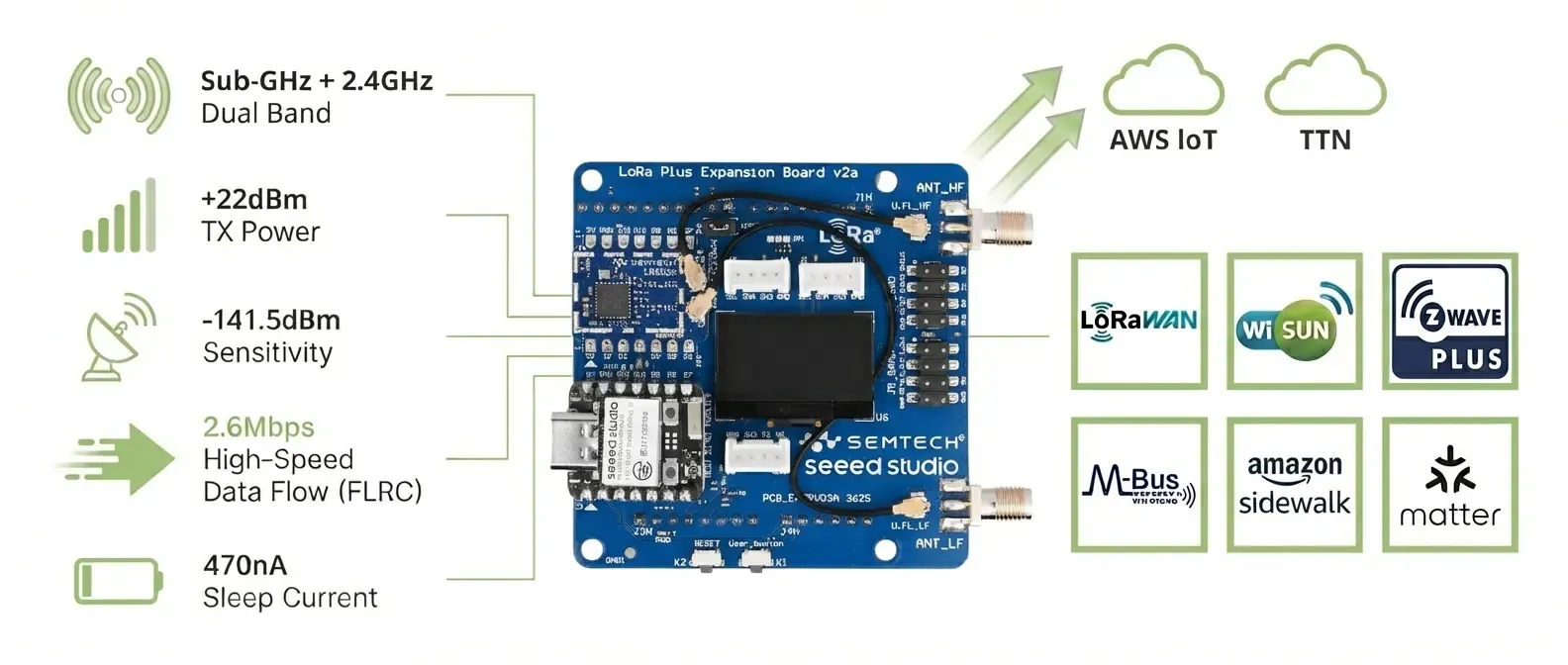
Oh, I should’ve known, SeeedStudio’s already got one available (4-6 week build time) as an evaluation board: Semtech LR2021 LoRa Plus Evaluation Kit with XIAO nRF54L15
Ready-to-Go for Arduino, STM32 & Nordic DK
SeeedStudio’s integrated kit combines real-time OLED feedback and plug-and-play Grove connectors for rapid sensor integration. Its hardware is pin-compatible with Arduino Uno, STM32 Nucleo, and Nordic DK platforms.
The github repro noted above has been specifically tested against the ST’s STM32 Nucleo-64 dev board in conjunction with the SeeedStudio dev kit.
Implications for MeshCore and Meshtastic
So what are the the implications for MeshCore of the new Semtech LR2021 chip?
Current MeshCore and Meshtastic devices, software & user interfaces assume we are only transmitting short text and sensor data at 62.5kbps bandwidth. The new LR2021 chip enables 3.2 times that data, up to 200kbps - in ideal situations. With that much bandwidth, the whole “~250 character text-only” mode of communications may be open for a major upset.
Maybe the same (limited size) data can be transmitted faster, resulting in 3 times as much network traffic before getting flooded, or maybe bigger data could be sent? I’m not advocating for one or the other, but this should provide some new headroom, or capabilities.
How do we even use the greater bandwidth effectively? Could this even be integrated into some progressive smartphone-type devices in the future, just as Bluetooth and Wi-Fi already are?
A huge consequence - especially as even more(!) users flock to an increasingly useful LoRa technology - will be the further congestion of the ISM spectrum. Already full of uses such as smart homes, baby monitors, cordless phones, garage door openers, thermostats, smart health, irrigation systems, smart agriculture, and pretty much anything with a sensor or GPS in it, we’re looking at overcrowding an already congested frequency band. Collisions are especially bad in urban environments; some West Seattle radio club members have already turned to StarLink, but rurally this could cause localized issues too.
Oh my. Change is afoot! This is all quite new, but it’ll be fun to see where & how this new hardware capability will be used. Fun ahead!
Update, Its not about max kbps
As it turns out, MeshCore intentionally only uses 1-3kbps currently where it currently could be set up to nearly 30kbps in real-world situations. This is done in order to deliver a quality signal further. Higher bandwidth perversely requires a higher density of repeaters, which means more hops and less distance traveled.
According to MeshCore Contributor @Cisien, the real impact of the new LR2021 is more likely to be the 5db theoretical (2-3db real world) additional sensitivity (from -137 dBm currently to -142 dBm), which should help the range/quality of existing links.