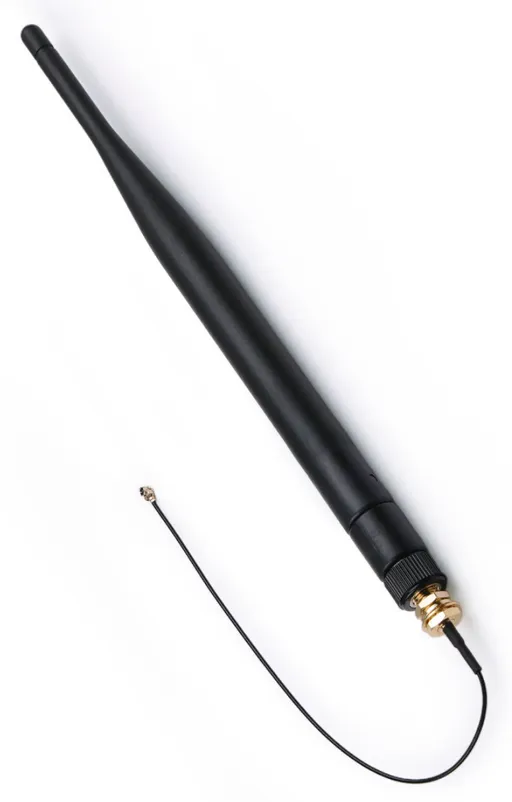
Specifications
- Gain
- 2dBi
- Size
- Approx. 82mm length
- Price Range
- $15-25
Pros & Cons
Pros
- ✓ Professional IoT-grade antenna from a certified manufacturer
- ✓ Accurate gain spec — Taoglas publishes full antenna characterization data
- ✓ Compact quarter-wave form factor — fits tight enclosures
- ✓ SMA connector standard; mounts cleanly through panel holes
- ✓ Used in commercial IoT products — well-tested and reliable
Cons
- ✗ Low gain (2 dBi) — similar to a well-tuned stub
- ✗ Not a range extender — good pattern, modest reach
- ✗ Higher price than generic alternatives for similar gain
- ✗ Rigid — less forgiving than flexible whips if knocked
Where to Buy
Taoglas TI.92
Overview
The Taoglas TI.92 is a quarter-wave whip antenna targeting the 868/915 MHz ISM bands, built to the level of reliability and documentation expected in commercial IoT product design. Taoglas is known for transparent antenna characterization — if you want the radiation patterns and impedance data, they publish it, unlike most consumer antenna vendors.
Why Taoglas?
Taoglas serves the professional IoT market — their antennas go into commercial devices where spec accuracy matters and failures cost money. The TI.92 is a “known quantity”: the gain is real, the pattern is documented, and the build is consistent batch to batch.
For hobbyist mesh nodes this is overkill from a specs standpoint, but if you’re building a semi-permanent outdoor enclosure or want to be absolutely sure your antenna is what it claims to be, Taoglas is a safe choice.
Performance
At 2 dBi, this is a dipole-class antenna. Its value isn’t raw gain — it’s pattern quality and consistency. The radiation pattern is near-ideal omnidirectional, which means no dead spots at angles where a poorly made antenna might have nulls.
When to Use
- Permanent node enclosures where you want a reliable, panel-mount antenna
- Commercial or semi-commercial deployments
- Any situation where you need documented specs for a project/grant/report
- Nodes inside waterproof outdoor enclosures (short antenna fits easily)
When NOT to Use
- Open outdoor installations where a 5–8 dBi fiberglass outperforms by a large margin
- Situations where price matters — generics do comparable work at lower cost for casual use