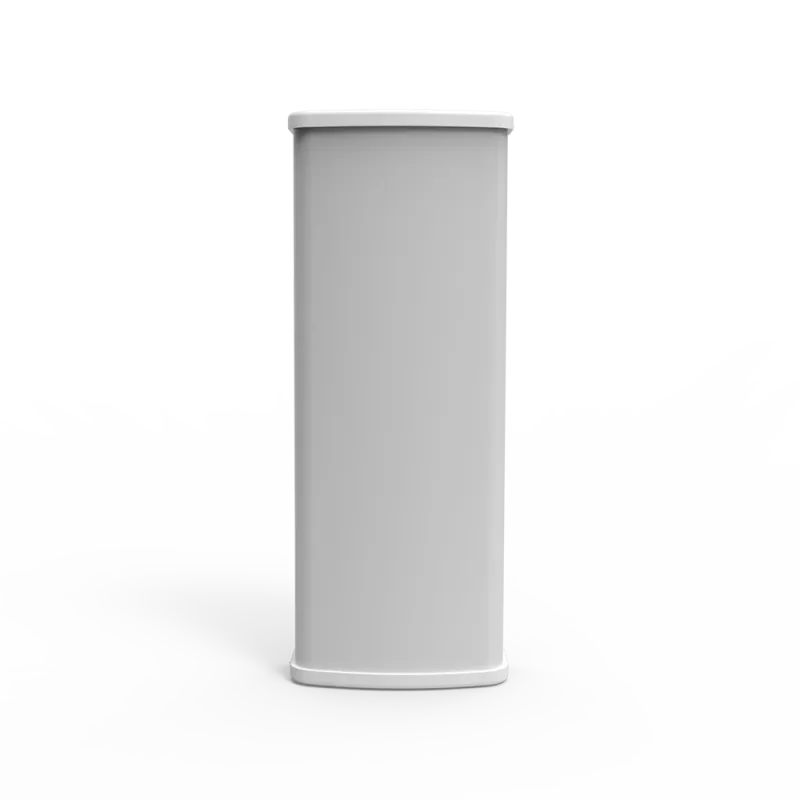
Specifications
- Gain
- 12dBi
- Size
- 750×280×125 mm
- Price Range
- $115
Pros & Cons
Pros
- ✓ High 12 dBi gain for maximum point-to-point range — bridges valleys, ridgelines, or water crossings
- ✓ Narrow 65° horizontal / 35° vertical beam rejects interference from off-axis directions
- ✓ Covers 860–930 MHz — works for US 915 MHz and EU 868 MHz LoRa deployments
- ✓ UPVC radome and included mounting brackets for permanent outdoor installation
- ✓ VSWR ≤1.5 — low reflected power, efficient power transfer
- ✓ Rated for –40 °C to +55 °C — handles Pacific Northwest winters without issue
Cons
- ✗ Requires precise aiming — small misalignment at 12 dBi is costly (each degree off-axis drops several dB)
- ✗ N-type female connector requires an N-type male cable (e.g., RAK Pulsar LMR-400) — cable sold separately
- ✗ Large footprint (750×280 mm) needs a sturdy pole mount; not suitable for compact installs
- ✗ Higher cost than the 9dBi version — best justified for long infrastructure links
- ✗ Only covers 1–2 nodes in beam direction — not a mesh hub antenna
Where to Buy
RAKwireless 12dBi Directional Antenna
Overview
The RAKwireless 12dBi Directional Antenna is a high-gain panel antenna covering 860–930 MHz, purpose-built for long-range, point-to-point LoRa links. It narrows the beam to 65° horizontally and 35° vertically, concentrating transmit and receive energy along a precise axis rather than spreading it in all directions.
This is infrastructure-grade hardware. For general neighborhood mesh use, an omnidirectional fiberglass antenna is the right choice. But when you need to bridge a ridgeline, reach across Puget Sound, or connect an isolated repeater node several miles away, this antenna can make connections that omnidirectionals cannot.
Specifications
| Parameter | Value |
|---|---|
| Frequency | 860–930 MHz |
| Gain | 12 dBi |
| VSWR | ≤ 1.5 |
| Horizontal beam width | 65° (± 10°) |
| Vertical beam width | 35° (± 10°) |
| Impedance | 50 Ω |
| Polarization | Vertical |
| Connector | N-type female |
| Dimensions | 750 × 280 × 125 mm |
| Radome | UPVC |
| Operating temperature | −40 °C to +55 °C |
| Mounting pole diameter | 30–75 mm |
When to Use a Directional Antenna
- Long point-to-point backbone links — spanning valleys, ridgelines, or open water
- Isolated node reach — extending coverage to a single remote location too far for an omni
- Interference rejection — the narrow beam rejects off-axis RF noise, improving SNR in noisy environments
- Gateway-to-gateway links — connecting fixed infrastructure nodes across multi-mile gaps
When NOT to Use This Antenna
- General mesh nodes needing to reach neighbors in multiple directions
- Mobile, portable, or backpack deployments — directionals require fixed alignment
- Indoor installations — the large panel and mounting hardware are impractical indoors
- Short-range links — the gain is wasted and the narrow beam may even miss nearby nodes
Installation Notes
Cable: The antenna has an N-type female connector. Use the RAKwireless Pulsar LMR-400 cable (RAK9732/RAK9734) or equivalent N-male terminated LMR-400 coax. Avoid cheap coax — at 12 dBi, cable loss directly subtracts from your range advantage.
Aiming: Use a compass bearing and verify line-of-sight on a map tool (Radio Mobile or HeyWhatsThat.com) before mounting permanently. At 12 dBi with a 65° horizontal beam, small aiming errors significantly reduce effective gain. If both link ends use directionals, aim them directly at each other for best results.
Mounting: Includes two brackets, compatible with poles 30–75 mm in diameter. Use a rigid, vibration-free mount — mast vibration in wind causes gain variation in a narrow-beam antenna.
Lightning protection: Strongly recommended for any elevated outdoor installation. Use an inline surge protector between the antenna and your radio equipment.
Comparison with RAK 9dBi Directional
The 9dBi version covers the same frequency range with a wider beam, making it slightly more forgiving of alignment errors. Choose the 12dBi model when you need maximum range on a confirmed line-of-sight path; choose the 9dBi when alignment is uncertain or the link geometry involves some angle variation.